




Modern Stonemasonry
Contents |
[edit] CNC engineering and water jet cutting
The craft of stonemasonry has been around for millennia and natural stone is still quarried and fashioned into blocks or slabs in much the same sequence of events as before.
What has changed dramatically is the machinery used to fashion the stone. Hand skills such as polishing and carving are still used to finish the work where appropriate but now the bulk of the process is accomplished by machine.
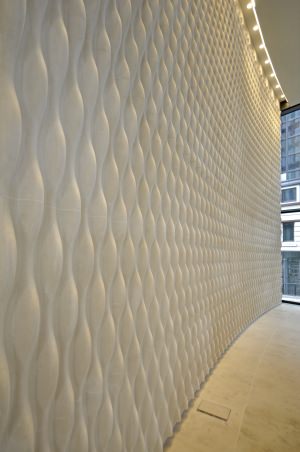
Machined Portland Stone feature wall at Two New Ludgate
[edit] 3D rendering
Architectural models or scans of existing objects can be used to generate surface files that are then sent to a CNC-equipped cutting machine, such as the 5-axis machine installed by stoneCIRCLE which can be used to rough out and saw blocks, as well as shape, contour, engrave and polish them. This is very useful for the production of large monuments or replicating architectural details for restoration projects. The articles can then be finished by hand if necessary.

A 3D rendering of a column capital used to generate surface files


Machining Portland Stone swags for a restoration project and the finished swags in situ at 159 Fenchurch Street.

Susanna Heron's Jaumont Yellow Limestone frieze, Henslow's Walk

[edit] Water-jet cutting
Water-jet cutting allows intricate patterns to be cut into stone to create inlaid work for surfaces such as walls and floors and for pierced lattices and grills. It can also be used more creatively as is shown in artworks by Rhona Smith and Julian Opie where bronze is cut on the waterjet cutting machine before being patinated and then inserted into routed Portland Stone.


An Age, An Instant by Rhona Smith features waterjet cut bronze set in Portland Stone

Julian Opie's art installations for CitizenM Hotel, Tower of London and the Hamilton Princess Bermuda use the same technique.

This intricate floor was produced using marble cut on the waterjet cutter and then inlaid into a Nero Marquina marble base.
[edit] Stone: still relevant
As the case studies above show, natural stone is still a relevant material that can be used to create award-winning new architecture. The use of modern technology renders the process much less expensive and time-consuming than it once was and this is made easier still by the use of a stonemason based in the UK with all the advantages of language and proximity that that conveys.
--Stonecircle 11:36, 11 Sep 2018 (BST)
[edit] Related articles on Designing Buildings Wiki
- Building with structural stone.
- Types of stone.
- Choosing stone.
- Kentish ragstone.
- Limestone for building.
- Masonry.
- Iraq, Afghanistan, Gulf War Memorial
- Julian Opie Art Wall CitizenM Tower of London Hotel
- Two New Ludgate Portland Stone Feature Wall
- Use of Stone in Monks Lantern Weybridge
- Bookmatched Marble for Boutique Hotel
- Portland Stone.
- Sustainable stone.
- Julian Opie Limestone & Bronze Frieze for Bermuda Hotel
- Voussoir.
Featured articles
Check out some of the best features and news from Designing Buildings as well as key stories from around the web.
Introduction to radon awareness

New technical information sheet published by CIOB.

Updated supplier guide can help electrical contractors engage with NHP.

CIAT confirm the winners of the 2026 architectural technology awards.

Government launches a one stop shop for flood preparedness.

Sir Edwin Lutyens: Britain's greatest architect? Book review.

CIOB publishes free template to help assess and manage risks.
ECA's reflections on Party Conference season

Burnham wants to be confident of winning before asking for a fresh mandate.
New Chief Construction and Scientific Adviser

Sergio Cavalaro, Professor of Infrastructure Systems at Loughborough University.
Building safety levy for England

CIAT publish estimator tool for members.

Water sector faces a growing crisis that could slow the delivery of vital infrastructure.
Undervaluing our industrial past

Heritage value changes as taste for building styles changes.
Changing expectations around competence and compliance

New information sheet from CIAT.